Wednesday, 21 October 2009

More Boobies Than Your Wettest Dream

  • "Peek-a-Boobie" - sorry, I just couldn't resist!

Just imagine the kind of hits that I am getting from Google with a title like that! That should boost my readership, shouldn’t it? Well, perhaps not, since I am betting that most of those hits are from people that don’t actually want to read anything – they would be more interested in the pictures. And not the pictures that I have, since mine will be of birds, of the feathered variety. So, if you were popping in for an eyeful of boobs and not birds, I suggest you take your dirty little mind elsewhere. For the one reader that is left, read on!

The Galapagos – rocky, volcanic islands in the middle of nowhere. Most of the islands are dry and barren, with little water and even less food. So why are they teeming with birds? Everywhere I look, there is a bird looking straight back at me. I have to watch every step I make, for fear of bumping into a booby, flattening a frigatebird or annihilating an albatross. There are eggs left all over the place and pathetic balls of fluff with gaping beaks littering the path. The poor stunted trees are festooned in feathers, the branches full of fowl. The air is no less busy a place, with more flight paths going overhead than Heathrow and Gatwick combined. The air is constantly swirling with a myriad of eddies and vortices caused by the passing wings of the wailing, screaming and screeching birds that call these islands their home. And the reason they are all here? Well, it is not like they have a whole lot of choice if they want some solid ground on which to lay their eggs and the seas around the Galapagos are rich in nutrients. These nutrients provide food for all manner of microscopic life, which in turn feed the millions of fish that inhabit the cold, equatorial waters. So, fish for all our feathered friends of these wondrous islands.


This brings me to the main subject of this post – the booby. Go on, snigger away, I know you want to. Now that you have got that out of your system, I can enlighten you as to why they are actually called boobies. The name is apparently derived from the Spanish term bobo, meaning stupid or dunce. A little harsh perhaps, but they are quite clumsy on land and will alight on any passing ship, meaning they are easily caught by sailors – anyone for roast booby? I prefer to think that the name refers to the rather clownish antics that they perform during courtship and their delightful and endearing nature on land. Here is one particularly cheeky chap that we found on the beach one day. He is a young blue footed booby and he seemed just as interested in us as we were in him.


So, let’s get started by looking at a few interesting facts about boobies. Did you know that a booby is one of the fastest water diving birds in the world? They can dive from heights of over 100 ft and hit the water at a speed of 60mph (100kph). This is the reason that I don’t have any photos of diving boobies, since none of my lenses are fast enough to catch them mid dive. To prevent brain injury every time they hit the water at that speed, they have an air sac in front of the brain to cushion it and protect it from the impact. To prevent water from spurting up their nostrils and power washing the insides of their skulls clean when they dive, they have permanently closed nostrils. A fascinating feature of the nests of ground nesting boobies is the almost completely perfect circle of guano that surrounds the nest. This forms because the booby tracks the sun as it moves across the sky, keeping its back to the sun to shade the eggs from its burning rays. Since the booby will not leave its eggs, when it has to go, it stands up and shoots away from the nest, resulting in an encircling ring of excrement. Why is it that when I start looking for interesting facts about any animal, I always end up talking about poop?
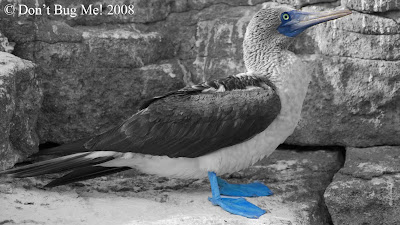

Now let’s have a look at the most famous of all of the boobies - the blue footed booby. It is easily recognised by its blue feet (no s#*^ Sherlock, you hardly need a PhD to work that one out, do you?!). But this does beg the question as to why these birds have feet that are so very large and so very blue. Let’s deal with the size thing first. Well, we all know that in a male big feet are a good indication of a big ................. O.K., let’s stop right there and get our minds out of the gutter, again. When a female is sizing up a male, she is interested in the size of his feet because that is what boobies use to incubate their eggs. Most birds have a brood patch, which is an area on the chest of the bird that is free of feathers and very rich in blood vessels. This allows the bird to snuggle down on the eggs to keep them warm. Boobies, despite their name, do not have this chesty feature. Instead, they use their very large feet. When a booby is incubating eggs, more blood vessels develop in their feet, which the bird then wraps around the eggs to keep them warm. Since both males and females incubate eggs, large feet are a feature that is favoured by females when she is sizing up a potential mate. As to why the feet are blue? Well, your guess is as good as mine on that one. The females obviously prefer blue feet and the male goes to great pains to show his feet off during the booby mating ritual. He will rock back and forth, lifting one foot off the ground and then the other, presenting them to his prospective mate. What appears to us to be a comical dance is apparently quite the turn on for a female booby.


Obviously not all boobies are so taken with bright blue, as we can see with the red footed booby. Now, you don’t have to be Naturalist of the Year to recognise the red footed booby. Having said that, they do have one sneaky little trick up their wings that might fool you - they come in two different colour morphs; a brown and a white form. Still, they are the only boobies that perch or nest in trees or shrubs, so life is good, life is easy. This had led me to ponder my choice of biological specialty, insects. Once in a while, I will see someone approaching me, clutching a jam jar or a margarine container and my blood will run cold. Uh oh, here we go, they have an insect or some other small creepy crawly in there that they expect me to be able to identify, since I am an expert, right? I will have a look and say something suitably intelligent like “Well, I think that it is an insect, but I have no idea what kind.” Pretty impressive, huh? You see, there are a lot of different insects out there – not just thousands or even hundreds of thousands, but millions, many of which haven’t even been described yet. So, the chances of me actually recognising one is much like the chances of me winning the lottery. I did win $1000 once, so I do get lucky sometimes, but really, I just tend to look like a bit of an idiot and people probably go away wondering where I purchased my PhD. Now, if I had decided to specialise in birds, well, that would significantly reduce the number of species that would need recognising. What about bats? They would be even better, since there are only around 1100 species worldwide. If I had specialised in bats, the chances of anyone actually bringing me one to ID would be pretty slim and even if they did I would stand a fair chance of recognising it and looking as though I actually deserve my PhD!


Anyhoo, I really am getting a bit sidetracked here, so back to the boobies. The last of the common boobies found on the Galapagos is the masked booby. If I am going to be factually correct at this point, I should admit that these boobies are technically known as nazca boobies, but the name masked booby just conjures up a much more humorous image – just imagine what the eyeholes might line up with! The nazca boobies were particularly prevalent on Isla EspaƱola, the most southern of the Galapagos islands. As we were walking around the rocky shore, I kept hearing gentle, clacking noises and soft, breathy whistles. It really did sound as though there must be an outing of old folks with ill-fitting false teeth just behind the next boulder. I was expecting to see some old dear, sitting in a rocking chair, knitting away to her heart’s content, while her husband sat next to her, slowly nodding off with a sigh and a snort. It turns out that what I was hearing were the nazca boobies. These boobies are another ground nesting species and, like the blue footed booby, have many breeding rituals. These include clacking their beaks and raising their heads to the sky while emitting a high pitched whistle. The males will also offer “gifts” to their mates, although I am fairly sure that this female was not very impressed with the stick that this male was trying to give her. Perhaps she would have preferred it if he hadn’t kept poking her in the eye with it? While these mating rituals are very endearing, the nazca booby is not all loving and giving. After breeding, the female will lay two eggs. The first egg will hatch two days before the second and, when it is old enough, the older chick will push the younger out of the nest, leaving it to die of starvation or cold. The parent will do nothing to stop this siblicide and the younger chick is doomed to its fate even before it has hatched.


So there you are, the boobies of the Galapagos. Now, I have never been much of a bird fan, but these boobies, especially the blue footed ones, are so charming and endearing that you can’t possibly not like them. A bit like penguins really, and we all know how much I like them, don’t we!

Monday, 5 October 2009

The One Place to See Before You Die.

You all must have heard of those books that tell you of all the places and things that you must see before you die? You know the ones that I am talking about – 1000 Places to See Before You Die or 1001 Natural Wonders You Must See before You Die. Well, don’t you find them all a bit depressing? How on Earth are you going to find the time and the money to visit ALL of these places before you die? Quite frankly, it is all a bit intimidating and a bit daunting and you start feeling like a failure because you know that there is no way that you will ever be able to get to all of those places before you pop your clogs and visit the One Final Resting Place, be that a hole in the ground, a fiery inferno or an eternal holiday, blessed with sun, endless hot water showers and no intestinal tract issues. So, I have decided to make it easy for you and I am going to write an abridged version which only requires you to travel to one place before you die. We should all be able to manage that, shouldn’t we? It won’t take you a whole year just to read the book, you won’t have to deliberate and agonise over which destination to go to next, there will be no long, tedious and annoying arguments with your partner (or with yourself, for that matter) over the merits of Angel Falls and Venezuela versus the undersea wonders of Indonesia and Papua New Guinea or the The Hanging Gardens of Babylon versus herds of wildebeest sweeping majestically across the plains of East Africa. OK, so the Hanging Gardens of Babylon don’t actually exist anymore, but you get my point.

So where is this one place to go before you die?

The Galapagos Islands.


After three and a half months tootling around South America, we finally made it to end of our journey, a group of small volcanic islands squatting on the equator, nearly 1000 miles from the coast of Ecuador. This is the place that inspired the whole trip. This is the place that I have been waiting to visit since I first decided that I was going to be a biologist, all those years ago when I was still suffering from buck teeth, a flat chest and National Health glasses. This is one of the places that inspired Charles Darwin, which helped to shape his ideas as he formulated his Theory of Evolution by Natural Selection. This is a biologist’s Holy Grail. And now that I had finally made it to the One Place that I needed to visit before I died, I was worried that I was going to be disappointed. How on earth could this place live up to my expectations? After all, I am a tad demanding and somewhat critical and just a teeny weeny little bit hard to please. What exactly is there to see here? Let’s make a list of what you can expect to see or not to see:


1. Volcanic lumps of rock, devoid of any obvious signs of life.

2. Volcanic lumps of rock covered in bird poo.

3. A lot of water – well, they are islands.

4. No elephants, lions, tigers, hippos, bears, antelope, moose ........ I could go on, but I am sure you get the point. For someone who loves to see lots of big and exciting wildlife, this does not seem to be the place to be.

5. Nothing especially dangerous. See above for large animals that might eat you or gore you to death, plus no venous snakes or snakes large enough to swallow you whole, no horribly large and hideous spiders with fangs the size of my little fingers, no scorpions or box jellyfish, no alligators or crocodiles. Now this might seem like a plus for many people, and I suppose that it is, but I do have this fascination with all animals, big and small, domestic and dangerous and I do get quite excited by the less liked and more reviled members of the animal kingdom. As far as I can see, the biggest dangers one faces on these islands is being hit by incoming bird shit or tripping over a lizard that looks suspiciously like a lump of volcanic rock – there is a lot of that around here. I suppose you could worry about stampeding tortoises, but I am guessing that you could avoid them by walking away.

6. No natural wonders such as snow capped mountains or lush and vast rainforest. No thundering waterfalls scouring out impressive canyons, no glaciers, no flower filled meadows, no towering trees, no glistening lakes.

So, to recap - lumps of rock with the occasional lump of sea lions and lizards that look like lumps of rock, with a lot of birds flapping around using you for target practice and a very fishy atmosphere wafting up your nostrils. There you have it, the Galapagos.


After this, I don’t think that I can expect a letter from the Ecuadorian Tourist Board seeking my assistance in selling holidays to the Galapagos anytime soon. You are probably not all rushing for your nearest computer or travel agent to book your holiday of a lifetime. You are more than likely changing the title of my post to “The One Place To Avoid While You Are Still Alive”.

So, what was it about the Galapagos that captured my heart? Why is it that, out of all the amazing, fascinating, breathtakingly beautiful places that I have visited over the years, the Galapagos rates as number one? To be honest, I am still not sure, but here are some of my thoughts.


The Galapagos are often thought of as the islands that inspired Charles Darwin, that led him down the winding path of thoughts and ideas that finally culminated in his Theory of Evolution by Natural Selection. While this may not be the whole truth, Darwin certainly did visit these islands back in 1835 and they did make a significant impact on his view of life and its evolution. He did not step ashore, see a bunch of different finch species and have a eureka, naked-in-the-bath moment. Darwin was a keen observer and a great collector of specimens, facts and ideas. He travelled the world and picked up pieces of the puzzle from many countries and many people. His greatest feat was to bring all of these ideas and observations, facts and thoughts together to come up with a theory that could explain the diversity of life on earth, a theory that would forever change the way we look at ourselves and our relationship to other animals and our relationship with God. Darwin changed the world with his theory and he changed man’s place in that world. We were no longer separate and apart from all other life forms, we were no longer the pinnacle of God’s creation. So, just being on these islands, seeing some of the things that Darwin saw, knowing that I was walking in Darwin’s footsteps sent a tingle down my spine. I had a sense of being somewhere important, being in a place that helped to change the world.


Since I am such an animal lover, it should come as no great surprise to anyone that I loved the Galapagos due to the weird and wonderful animal life that can be found on the islands. Is there anywhere else you can go where you can find marine lizards feeding on seaweed or an assortment of tortoises that are big enough to ride (although I would have to wonder why you would want to, since it is far quicker to walk to wherever it is you want to go and it would not exactly be a thrill a minute). Where else can you find a slew of finches that have beaks of all shapes and sizes that can cope with diets of seeds, grubs, nectar and even blood or a bunch of boobies with bright blue feet prancing and dancing around like drunken sailors who have not found their land legs yet? Where else can you see pairs of albatross clicking beaks and dancing for each other oblivious to the world around them or penguins at the equator – oh yes, there are even penguins here, and that will always make me happy! There is nowhere else on earth that you can find some of these creatures, there is nowhere else you will see this assortment of bizarre but loveable animals and this makes the Galapagos a very special place indeed.


But I suspect that the most compelling reason for me ranking the Galapagos as the One Place is the fact that the animals don’t run, waddle, hop, swim or fly away. I spent 90% of my time in the rainforest gazing up into the canopy trying to convince myself that I really could see the monkey/porcupine/bird/anteater that the guide was patiently trying to point out to me. I spent the other 10% of my time trying to capture those small blobs that my guide assures me were monkeys/porcupines/birds/anteaters with my camera using my biggest zoom. The rainforest was fantastic and when you finally did see something or catch it on film, you would be delighted. But for far too much of the time you just stood there, gawping up into space getting a very stiff neck. The Galapagos were completely different. Throw away those binoculars; don’t bother lugging around that behemoth of a lens. You won’t need them. If you want a closer look at that bird or those lizards, just walk a bit closer. That sea lion not close enough? Well, give it a minute and it will probably flop its way over to see you. Just be careful where you step or you might squash one of those adorable little sea lion pups with its eyes of liquid chocolate or trip over a booby having a nap. This really is the place to go if you want a close encounter of an animal kind.


So, there you have it. Lumps of rock, yes, but oh so much more. I suspect that I have not been able to convey the true majesty of these islands, but I hope that I have given you a taste of their magic, their beauty and their allure. While I hope that some of you may now be tempted to wander their way there, please don’t all go there at once – that would kind of spoil it.

Sunday, 13 September 2009

The Fourth of the Fourth

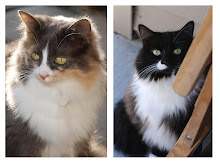
So, it is Sunday morning and I am up early. Why? Because of a ball of grey fluff, aka Willow, who decided that she didn't care that it was Sunday, she wanted out NOW. She did all the usual sitting on top of me, breathing right in my face, close enough so that her whiskers tickled my nose, purring in my ear, pawing at my armpit, walking up and down me while meowing. She even dragged all of her toys out of the closet, along with a t-shirt and a bra and a lot of yowling. OK, OK, I give up ............... out you go!


Is it just me, or does she look evil?

You may have noticed that I haven't been very active in the blog world of late - well, I have been on holiday and this means that I have done nothing. But all good holidays come to an end and so I am back. I still haven't finished my little jaunt around South America - I will get to that soon, but I was sent a little challenge by iRamble, so I thought that I would start back with that.

Here is the challenge, it is up to you whether you want to accept it:

Go to your picture folder, find the fourth photo, post it and explain it. Now, I have lots of photos, all organised into folders within folders, so I went to my fourth folder and picked the fourth photo in that. And here is what I found..........


Isn't it odd, all that travel that I do, all those thousands of shots of exotic flora and fauna from far flung places around the globe, and I end up with a picture of a bluebell. Taken in a pot just outside my front door.

So, what does this photo mean to me? It means home, it means memories; it means far more than many of the shots that I have taken while travelling the world. It takes me home, back home to England. It evokes memories of my childhood, of walks in the woods with my family, with my dog. Every May, even after twenty years of living away from home, I always think of the bluebells. Of that sea of blue, rolling and shimmering beneath a sky of vibrant green as the beech unfurl their fresh new leaves for another year of life.


It is amazing that a photo taken so close to home can take you so far in time and space.

Friday, 7 August 2009

P-P-P-Pick Up a P-P-P-Penguin!


  • “It’s practically impossible to look at a penguin and feel angry.” - Joe Moore.


Now, I have no idea who Joe Moore is, but he does have a point. I have my own version:

  • “You can never look at a penguin without smiling.”

Go on, look at this little guy and tell me that a smile did not materialise on your face.


So, I have a plan for making the world a happier, smilier place. Everyone needs a penguin. Just think of all those situations that make you angry, make you mad, make you want to punch someone in the face or poke them in the eye with a sharp stick. Now imagine that situation with a penguin. For example, I hate bad drivers. You know the ones that I am talking about. The ones that cut in front of you, that don’t signal, that sit in the overtaking lane, not overtaking. Now, in a normal situation, I might get a little flustered. I might even get a little annoyed and a few colourful words might escape my lips. But, if there were a penguin in the car, perhaps sticking his head out of the window, feeling the wind blowing through his feathers, well, all I would do then is smile and perhaps wave at the offending driver, in a happy, carefree way rather than in a one-fingered, offensive way. See, penguins could be the cure for road rage. They could work in any situation. Imagine traffic wardens if they walked around with penguins. We would all look forward to meeting one. What if we all had a penguin in our shopping carts? What fun shopping would be and we wouldn’t care if we had to wait at the checkout or if some old geezer cut in front of you with a trolley that obviously contained more than 15 items. So what, he has a penguin. Oh, and nobody likes a politician, right? What if there were a penguin party and each candidate campaigned with a penguin. I know where my vote would go. It might also work on a smaller scale too. Think of those bland, infuriating tax forms that you have to fill out every year. Wouldn’t that task be just a little less taxing if there were pictures of penguins strategically placed throughout the document? The possibilities are endless. Just think of your least favourite person, your most annoying chore or your most hated activity and now imagine it with a penguin. There, isn’t that better?

Magellanic penguins on Martillo Island, Argentina

So, just in case you haven’t got it yet, I love penguins and I am not talking about the chocolate biscuit variety. I was one very happy camper once we hit Southern Patagonia. We visited two penguin colonies, one in Chile (the Seno Otway Penguin Colony on the Strait of Magellan) and one in Argentina (Martillo Island in the Beagle Channel). The Seno Otway colony was exclusively magellanic penguins, while at Martillo Island we were also entertained by a small number of gentoo penguins. So, what is it about penguins that I find so endearing? Well, you just have to look at them - their cheeky little faces with their inquisitive expressions, the way that they cock their heads to one side to get a better look at you. I love their roundness and their simplicity. Penguins appear to be down-to-earth, uncomplicated animals. They stand around, surveying their surroundings with a little smirk on their faces as if they know something that you don’t. If they want to lie down, well, they just fall over where they are standing. If there happens to be another penguin there already, oh well, that just makes for a softer landing.


What you can’t see from still photos is the way they move around and their oh-so-endearing behaviour. On land, they are clumsy, ungainly and awkward. They waddle around, looking lost and forlorn, desperately seeking the company of other penguins. They really don’t like being left on their own, preferring to travel in little gaggles or groups – a waddle of penguins? If one decides to waddle off, the whole group has to follow. If one decides to stop, so do the rest. If one gets left behind, you can almost see the panic in its face as it hurries along, desperately trying to catch up, in a hoppy, jumpy sort of run.


When they know that they are being watched, you can almost see them trying to be graceful and poised. This invariably ends up with the penguin face-planting in the grass, picking itself up, shaking down its ruffled feathers and waddling off with its head held high, hoping that no one noticed its awkward clumsiness. Then there was the magellanic penguin that found itself in amongst the gentoos. I can just imagine the thoughts racing through its tiny little mind:

“Oh guano! These are the wrong penguins! OK, stay calm, take a deep breath, pretend nothing is wrong, all is well, no problems here, just strolling through, don’t mind me..............waddle away, waddle away!!!!!!”

His little head shot up, he looked worriedly from side to side, and he waddled as fast as a penguin can waddle. Not that the gentoos appeared to be any threat. In fact, they completely ignored the wayward intruder, too busy incubating their eggs to worry about a panicking penguin.


Now, me being a biologist and all, this post would not be complete without a few interesting little penguin facts. Did you know that............

The black and white colouring of penguins is used for camouflage. The white underbelly is hard to see by underwater predators looking up towards the water surface, while the black backs are hard to see by above water predators looking down on the penguins.

The largest living penguin is the emperor penguin, standing 3’ 7” tall. The smallest penguin is the little blue penguin (aka the fairy penguin), which is only 16” tall. There used to be penguins that were as tall as humans, living 35 million years ago in Peru. I am not so sure that they would be quite so cute..........I wonder what they ate?!

Penguins have the smallest eggs, compared to body weight, of all birds.


The word penguin may have originated from the Latin pinguis, meaning “fat”. Well, you would want a little extra insulation if you lived in such a cold climate, wouldn’t you?

There is a species of penguin called the macaroni penguin. Not an intellectually inspiring fact, I grant you, but the name made me chuckle.

The wings of penguins are very stiff and have evolved for flying underwater rather than in air. The fastest penguin recorded, a gentoo, made a top speed of around 30kph. Just to give you an idea of how fast this is, the Olympic gold medallist Michael Phelps’ top speed is approximately 8kph. Go, penguin, go!

The deepest recorded dive for a penguin, the emperor penguin, is 565m, or 1,870ft! Now that is deep. As a scuba diver, the deepest that I have ever gone is around 50m. My husband, with all his fancy gas mixes, has made it to about 75m. The deepest ever scuba dive was to 318m and the deepest breath hold dive was to 214m. Makes the little old penguin look pretty good, doesn’t it?

Penguins can hold their breath for up to 22 minutes. Don’t try that at home!


You can get an idea of the age of a penguin by looking at their feet. Younger penguins have a blotched pattern on their feet, which fades as they age. A bird over 10 years will usually have all black feet.


This one must be getting on a bit, since his feet are all black.


This one is for EnglishMum - Gentoo penguins have pink poo. This is due to all the krill in their diet.

You have probably all heard about the homosexual penguins of Central Park Zoo. But did you know about the penguin prostitutes of the Antarctic? Apparently, some female penguins will sell sexual favours in return for rocks. Many penguins, such as the gentoos, use rocks to build their nests and these rocks are a precious commodity in penguin society. It appears that these promiscuous penguins do have a life partner, but will turn tricks on the side for extra rocks. The trusting mate appears to be completely ignorant of his partner’s indiscretions. This reminds me of a quote I once read:

“Penguins mate for life. That doesn't surprise me much because they all look alike. It's not like they're going to meet a really new, great looking penguin someday.” Author unknown.


Of course, not all penguins build their nests from rocks. Magellanic penguins nest in burrows or under dense bushes, collecting bedding material, such as dried grass, from the surrounding areas. Strikes me as being a wee bit more comfortable than a pile of rocks, but I guess if your home is the frozen wastes of Antarctica, you do not have a busting lot of choice.


I feel that it would be unfair of me to leave you with the impression that penguins are the bumbling buffoons of the bird world. We tend to only see penguins in our part of the world, the dry land part. It has to be said that penguins are not shining examples of life well adapted to terrestrial living. However, if you were to follow one into the aquatic realm, everything would change. Here, we can see the penguin at its finest, in all its streamlined glory. You would be able to see one torpedo though the water, leaving just a trail of bubbles. If you could keep up, you would witness its skill and grace, how it can fly through the water, changing direction with a flick of a wing and a turn of the head. On land, a penguin is clumsy and ungainly, a little on the chubby side with short stubby legs. But underwater, a penguin is an aquatic work of art. Wings that are useless on land propel the penguin through the water with the agility and grace of a bird of prey on the wing. The sleek, smooth body cuts through the water with effortless ease, whirling and twirling, twisting and turning, so stiff and reserved on land, so free and liberated beneath the waves. It is so easy to forget that the penguin, in its watery element, is a beautiful, elegant and mesmerizing sight when you only ever see them blundering around on land.

Having said all of that, I am going to leave you with a couple of photos of just one of the many penguins that made me laugh while visiting the Martillo Island penguin colony.


“I can fly!” ............................................ “No, I can’t...........”

Is it possible that a penguin might be able to fly?

Well the BBC seem to think so............


By the way, for all you non-British types, the title of the post is based on a now quite old advert for a chocolate biscuit with the unlikely name of a Penguin.

Thursday, 30 July 2009

It's the End of the World.

I am going to have to start this post with a teeny, tiny confession – I am the Queen of procrastination and the winner of the gold medal for laziness. I excel at doing absolutely nothing for long periods of time and I never cease to amaze myself at the huge amounts of nothing that I am capable of doing. At the beginning of summer, I wrote out a long list of everything that I was going to accomplish this summer – see, I know how useless I am at getting anything done, so I thought that if I wrote out a list of things to do, I might actually do some of them. Well, that has not worked out so well. I checked it yesterday, and I don’t think that I can cross anything off the list. I have not de-matted the cat yet (I gave up on that one for health reasons. The mats seem to remove themselves after a while anyway), I have not put up the curtains in the living room yet (I did try, but apparently no one sells long, white wooden curtain rails anymore). I have not bought new bookcases so that I can reorganise all my books into subject area and then alphabetically by author, yet. I have not volunteered at the local SPCA to walk the dogs yet (again, I did try, but you have to be officially orientated before you can volunteer and their next orientation is not until August the 8th, the day I leave go on holiday). I have not taken a course in macro photography yet or how to use Photoshop yet. I have not written my book on my trip to South America yet. I could go on and on, which would enable me to avoid doing the other thing that I have not done yet and that is finish writing my blogs about my trip to South America. You see, it has been nearly a year since we left, seven months since we returned and I seem to be stuck at the End of the World.


Ushuaia, the world’s southern most city. It sits on the edge of the Isla Grande de Tierra del Fuego, dipping its colourful toes into the waters of the Beagle Channel. From here, you can catch a cruise ship to the South Pole, take a plane trip over the glacial fields of Southern Patagonia, eat more meat than you have ever dreamt of or spend your time perusing the tackiest souvenirs that you have ever laid eyes on. Now, I did not do any of those (OK, so I did pop into one souvenir shop just so that I could marvel at all the rubbish that was available and wonder who on earth actually ever buys any of it – I can only assume that a lot of people like to buy a lot of gag gifts for friends or that many people have numerous relatives that they really don’t like). My time at the End of the World was spent walking along the beach, cruising the Beagle Channel and hunting down penguins to shoot, with my camera, of course. Now, I know that you all want to see the penguins, but you are just going to have to wait. I know, I know, I promised penguins, but how else I am going to keep you coming back to read my blog if I don’t have anything to entice you back with?

The cruise of the Beagle Channel was a feast for the eyes, ears and nose. For the eyes, there were views of Ushuaia and the mountains crowding around the city, pushing it ever closer towards the waters edge. As we motored away from the city, the southern beech trees, stunted and deformed by the ever-present winds, blanketed the coastline, their muted greens and greys contrasting sharply with the bright orange and yellow lichens that encrusted the rocks tumbling down into the sea. The wind whipped around our heads sending hair flying into our eyes (well, mine anyway – Mr. DBM's is all a bit too short and lacking to be windswept and tousled by the wind). The air was cold and fresh with a slight salty tang and I was loving every lungful until the feast for the nose hit me. Phoar, what on earth........????? The smell was just horrendous. Think of a trip to a local fish market, late in the day, after the fish have been sitting out in the sun. Take that fish, whirr it up in a blender, leave it in a bucket for a couple more days and then drop into a pit of sewage. And there you have it, the smell that walloped me in the nose as we rounded a headland and drew close to a series of small rocky islands in the middle of the Beagle Channel. Before sight or sound came the smell of the sea lions.


As the boat drew closer, you started to hear the barking and honking of these blubbery bags of fermenting fish and then finally, as the island drew closer, you got your first sight of the malodorous creatures. And once you finally did lay eyes on them, you could not help but forgive them for their stinky emanations – well, how would you smell if all you ever got to eat was fish, fish or fish? OK, so many of them were also a bit cantankerous, with a lot of arguments about who was going to sleep on which bit of rock or who was going to be on top of the slumbering pile of pinnipeds. There was much showing of teeth and blowing of foul breath right into the face of an argumentative relative but when quiet descended on the sea lion colony, in those peaceful moments, you could fall in love with their puppy dog faces and their serene, peaceful smiles.


The lovable sea lions were not the only ones contributing to the stench wafting around these rocky islands. There were also all the seabirds that made their home here. And what do sea birds like to eat.........oh yes, more fish, fish or fish. Many of the islands were covered in colonies of imperial shags (don’t even think about making a joke about that) or king cormorants (I never could tell the difference) and dolphin gulls. There was much screeching and wailing overlaying the honking and the barking of the sea lions. A delight for the eyes, but a bit harsh on the ears and the nose!


The following day, we went for a much more serene and less odiferous walk along the beach. For a moment, I could almost convince myself that I was back home, strolling along a beach in Beautiful British Columbia. The pristine shoreline was surrounded by snow capped peaks and along the edge of the beach the trees struggled for a foothold on the rocky headlands and slopes leading down to the beach. The air really was fresh here and all was quiet, peaceful and tranquil.


It was only when I looked more closely at the trees that I realised just how far from home I had come. Instead of the coniferous trees of northern latitudes, these shores were covered in southern beech trees clothed in tiny, green leaves rather than grey-green needles. However, just as with the conifers exposed to the storms of the west coast of British Columbia, these trees showed the effects of the harsh conditions of Southern Patagonia. Some looked as though they had been flattened and sculpted by the wind, while others were gnarled and misshapen, twisted and broken by wind and snow. You could see that their whole lives have been spent battling the elements and you have to admire their tenacity and ability to survive through everything that nature throws their way. Another oddity that set these trees apart from the shoreline forests of B.C. was the occurrence of the oranges growing on their branches. Oranges!?! How could you possibly have oranges growing in such a cold climate I hear you all cry? Well, obviously they are not actually oranges, but at first glance that is what they look like. After a little investigation and a couple of dissections later, Mr. DBM and I decided that they were a fungus. Further research revealed that they are in fact Cyttaria darwinii, more commonly known as Darwin’s fungus or Indian bread. This parasitic fungus grows on the southern beech trees in huge numbers. Some trees looked as though they had been decorated for some special orange festival and appeared to be more fungus than tree. Apparently, they are edible and, according to Mr. Darwin, they have a mucilaginous, slightly sweet taste. They did not look very appetising to me and so I cannot tell you whether this is true or not.


Our stroll along the beach finally brought us to the end of the road – literally. We had reached the end of La Ruta Nacional No. 3, the end of the Pan American Highway. This road runs all the way from northern Alaska down through the Americas to end here, nearly 25,000km later. Unfortunately, you can’t actually drive all the way from northern point to southern tip due to the missing link of the 87km Darien Gap, an area of swampland that separates Panama and Columbia that is impassable by land vehicle. While we were taking photos of the sign, a group of tourists came up and one, in a very loud voice asked “Why does it tell us how far it is to Alaska? Why not New York or Boston?” I suspect that she may have overheard my muffled laughter and my barely disguised guffaws of derision. Well, really!


So there you have it. We have reached The End of the World. For much of the time that I spent here, the song “It’s the End of the World as We Know It” by R.E.M. rattled around in my head in a very annoying fashion. I also spent an inordinate amount of time loving everything about that part of the world, the mountains, the water, the flora and the fauna. I even found the perfect spot to build my house, with perfect views from every window. Even The Boys found a perfect little spot with a perfectly wonderful view...........


P.S. Some of the more astute readers may have noticed a slight anomaly between the length that I gave for the Pan American Highway and that given on the sign. I have no idea why the numbers are so different, but I got my figure from Wikipedia, so I must be right, yes?