Sunday, 28 March 2010

Macro Monday: Things That make You Go ...Ahhhhhh....

Is it Monday again? Already? How time flies when you are trying to buy a house, get a mortgage sorted out, do 50 million house inspections with electricians, contractors, plumbers, window specialists, eco-consultants etc, all before your deadline of Thursday - well, it can't be any later, can it, since it is the Easter Weekend and we can't possibly leave it until after then, can we?

So, I might be wimping out a wee bit this week, but I have resorted to just finding something cute, something that everyone can ooohhh and ahhhh over and something that I don't have to explain or write endless paragraphs about some obscure lifecycle or association with some peculiar gut protozoan that nobody has heard and few actually want to hear of. So, here you are, a Galapagos sea lion. Isn't he adorable?


OK, so just a couple of things, just in case you ever need this information (and I am sure that one day you will and you will be forever grateful that you bothered reading this far into my post). How can you tell the difference between a sea lion and a seal? Anyone? Come on, I know someone out there knows the answer. Oh, alright then, I will tell you. A sea lion has external ears (you can just see them in this photo), whereas a seal does not and a sea lion has long front flippers and can walk on all four flippers on land, whereas seals kind of hump along and are very clumsy on land. Also, if you happen to have a beach ball handy, you can tell the sea lion since it is the one that can balance said beach ball on the end of its nose.

Now, I really must stop this blogging malarky, since I have a stack of marking a mile high that has to be done. I don't suppose anyone actually cares about this, but there you are. Part of the reason that I haven't done it yet is due to the fact that I spent half of my day weed wacking a blackberry patch the size of a football field just so those bird nerds that I have been hanging out with lately can put up more nets to catch more unsuspecting feathered avians. I don't think that was mentioned when I signed up for the whole bird watching thing. You see, physical labour and I don't get on very well together. Hmmmm, perhaps I shouldn't be buying a house that comes with half an acre of land. But then, I do have Mr. DBM.....

OK, I have to stop rambling now - I have marking to do. Did I mention that?

Perhaps I have time for one more photo - this time we have Californian sea lions at Pier 39 in San Francisco. Everybody.....aaaahhhhhh......


For more Macro Monday, go here.

It has been pointed out to me that this is a Face to be Loved, so I have included it in a Faces meme. Go here for more.

Sunday, 21 March 2010

Macro Monday: Happy Birthday!

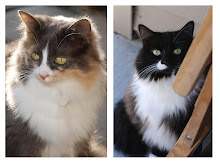
How could I resist? Today, my adorable little kitties turn eight and this is as good an excuse as any to post their photos, again. I have written many posts about my cats, talking at length about their shortcomings and how useless they are on a practical level - here is the most recent. But today, it is their birthday and so all I shall say is that they light up my life, make me smile when I am feeling blue and, all things considered, make my life and my home a better place to be.

Since this is a Macro Monday posts, here they are, in all their close up cuteness and fluffiness.


Did I ever tell you how hard it is to photograph a black and white cat? Getting the right exposure is nearly impossible. It is like trying to photograph a lump of coal on a fresh bank of brilliant white snow, except that the lump of coal refuses to sit still, even if you do try and tempt it with some cat treats.

For more Macro Monday - go here.

Friday, 19 March 2010

Seeing Things in Black and White

For those of you who have not sussed it out by now, I am currently taking a Photoshop course. This week was black and white conversions. Who knew that there were so many ways to turn a colour photo into a black and white version? And who knew that you can generate an almost infinite variety of different black and white photos, depending on the conversion process used and subsequent editing? Well, I do now, and after a little messing about with Photoshop at 2am this morning (it is amazing what you can get done when you can't sleep), here are just three versions of a photo that I took of the Altiplano of Peru.


I am not entirely sure which one I like the best - it seems to depend on my mood. The top and the bottom photos have both had slight tints added, so they are not 100% monochrome.

Next week - how to make anyone look good. Not sure if I will even go to that class, given the almost complete lack of people in my photos. Let's face it, even when I do include a person, it is usually yours truely and since I am such a shy and retiring person who shuns the limelight, I always blank my face out. Besides, aside from removing very large, obvious and embarrassing zits, I am not a big fan of photoshopping someone's image until they look great, but absolutely nothing like themselves.

Oh, and for anyone who is interested, here is the original image before the B and W conversion.


Sunday, 14 March 2010

Macro Monday - Don't Pick the Prickly Pear by the Paw......


It would appear that I am now one year older, but none the wiser. Being 28, again, is getting a little tiresome. Still, one thing that I have learnt is that you should never pick the prickly pear by the paw - just look at how many spines cover the surface of the succulent leaves of the prickly pear cactus. And have a look at the interesting effect of removing all colour from the photo except for the reds. As you can see, I am still messing about with Photoshop.


And since I seem to find it nearly impossible to write a post without some educational content, let's end with a few interesting facts about the prickly pear cactus. This particular one was photographed on one of the Galapagos Islands. On some of the islands, these cacti are fairly small and grow low to the ground. These islands tend to be wetter and more fertile and their resident tortoises have large domed shells which prevent the tortoise from stretching its head up very high - with all the food nice and low down, he doesn't have to. However, on some of the drier islands, the prickly pears grow into large "trees", with strong trunks holding their pad-like leaves well off the ground. On these islands, the resident tortoises have evolved saddle-shaped shells that allow them to stretch their heads up high to reach the lower cactus leaves. On all of the Islands, the prickly pear provides an important food source for many of the animals, not just the tortoises, inlcuding nectar for many of the islands different finch species.


The prickly pear is native to all of the Western hemisphere and is one of the most northern, cold tolerant species of cacti, managing to survive all the way into British Columbia, Canada. All prickly pear cacti belong to the genus Opuntia and they can make a tasty treat for humans as well as animals. To be honest, I might be lying here. I do know that you can eat various parts of the plant, but since I have never tried any part, I cannot say for sure that any part is actually tasty. Still, you can always give it a go. You can eat the fruits or the young leaf pads, but you will probably want to make sure that all of the spines have been removed first! In Mexico, the fruit is commonly called tuna, but I suspect that if I called "tuna" and my cats came running they would not be best pleased if I offered them catus fruit! The Mexicans and some South Americans also make use of the prickly pear to cultivate scale insects, from which red cochineal dye is produced.


And finally, since it seems to me that I cannot learn about anything biological without Mr. Charles Darwins' name popping up, I might as well tell you that he discovered that these cacti have thigmotactic anthers. That is just a fancy way of saying that their anthers (male bits that produce pollen), move when you touch them. Oooh eerr, missus! I think that I will say no more about male bits moving when you touch them.........

For more Macro Monday, go here.

Sunday, 7 March 2010

Macro Monday - Painting with Light


So this week I have chosen a photo that, while it looks as though it has been photoshopped quite a lot, it really hasn't. I will admit to removing the stem, since I liked the impact of just the flower head, and I have adjusted the contrast, but otherwise, it is pretty much as is. The distinctive look of the photo has been achieved in the way the photo was taken. Rather than using a harsh flash with a fast shutter speed, I essentially took the photo in the dark. The lighting was then provided by playing a flashlight over the flower head, lighting up the petals, but leaving everything else black. To get enough light into the camera using such a subtle form of lighting, the shutter has to be left open for a relatively long period of time, in this case approximately 15 seconds. Obviously, you are going to need a tripod for this one.

I really do love this effect, and you can do it on a much larger scale, so long as you have a strong enough light source. Here is a tree that I painted with light in the Namibian desert. I got into trouble for this one, since apparently leopards live in amongst the boulders and they love to come out at night and eat idiotic tourists (that would be me) that are sitting around taking photos at sunset.


For more macro Monday, go here.


Sunday, 28 February 2010

Macro Monday Mystery


So, what do you think made these tiny little sand balls, each with a diameter of approximately 0.5cm? Here is a secondo shot, from further away, to give you the bigger picture. These tracks and sand balls were found on a beach in the Galapagos.


I might regret posting this one, and I might be getting some irate comments from such bloggers as Baino, who seem to be getting a little frustrated with posts such as this and the weekly Macro Monday puzzle from Jay, over at the Depp Effect. But, to be honest, I am in New Orleans right now and so I have other things to do - did you know that you can get "gentlemen" to give you a string of beads if you show them your boobs on Bourbon Street. Well, I didn't, and trust me, I will not be getting any beads tonight! But I can hardly sit in my room all night composing blog posts, can I?

For more Macro Monday posts, go here.

Oh, and I guess that I should tell you that I don't actually know what made the sand balls. I have my suspicions, but I am really hoping that one of you bright sparks out there can actually tell me. So, please don't get upset when I can't give you the answer on Tuesday. You have been warned.

Sunday, 21 February 2010

Macro Monday - Fact or Fiction?


Every-so-often, as I am messing about in Photoshop, I stumble across an image that I love. But the question is, where does photography end and art begin? When do you cross the line between fact and fiction, truth versus lie, real or fake? Generally speaking, I am on the reality side of the line - I use Photoshop to enhance the photos that I have taken, but keep them realistic and true to the subject. But occasionally I cross the line; I leave the realm of real and enter the territory of art. I think that this is OK, but what do you think? Do people go too far with Photoshop?

Here is the "real" photo - the first photo is this one inverted.


For more Macro Monday, go here.


Thursday, 18 February 2010

And the Gold Goes to........

So, I am just a little bit curious as to how the world is viewing the Winter Olympics here in Beautiful British Columbia. I only ask, because I seem to hear a lot of whinging and whining, complaints and negative press here in Vancouver. The hydraulics not working during the opening ceremonies, the lack of snow at Cypress Mountain, the bad weather, the delays, the malfunctioning of the Olympia ice machine (they have bought in a replacement Zamboni from Calgary – I can imagine it driving along Highway 1, leaving a beautiful, smooth and shiny surface on the pass through the Rocky Mountains, cars and trucks spinning out of control, flying off the road behind it), the demonstrations and disruptions by anti Olympic protestors, the barrier preventing people approaching the Olympic flame, incompetent security.......I could go on, but I won’t. Let’s face it, the only really serious issue was the death of the Georgian luge competitor, Nodar Kumaritashvili. While this was indeed tragic, nobody could ever argue that a sport where you hurtle down a track at 90 mph on a tea tray can ever be 100% safe. As for the weather, well, that is hardly anyone’s fault, is it, although you could argue that holding events at Cypress Mountain, which is only 1000m above sea level, was rather foolish. We often gets years when the mountain is shut down due to lack of snow and too much rain. Now, being British, I should be used to lots of complaining and finding fault in everything, but I have to say that Canada is giving Britain a run for its money on the whinging front, and could even win the gold this year. Besides, the British really should be careful with its criticisms, since they are holding the Summer Olympics next, and there are a whole lot more things that can go wrong in a Summer Olympics.

Having said all that, today the sun is shining and the world is seeing Vancouver in all its glory. When you see the city surrounded by shiny, bright white mountain peaks and the deep blue-green ocean, the sun sparkling off the rippling water, reflecting off the glass towers, highlighting the sails of Canada Place, you will all want to come and live here (but please don’t, house prices are already far too high). So quit your whinging and your whining and enjoy the Games!

Since I am trying to encompass the Olympic spirit, I thought that I would see if I could find any animal winter Olympians. Here are my choices for medal winners:

And the bronze goes to Japan, with its snow monkeys of Honshū. Also known as the Japanese macaque, these are the most northern living and most polar living non-human primate. These guys are not stupid and they know a good thing when they see one. While the outside temperature can drop below -15oC, the temperature of these hot water springs remains toasty warm all year long. Out of the water, the macaques are kept warm by their incredibly thick fur. Between bouts of looking for food and messing about in the snow, rolling, but not throwing, snowballs, they head back to their hot tub to relax and chill out. All this one needs to complete his bliss is a nice cold glass of Sapporo.

And the silver goes to the U.S.A, represented by the red fox, Vulpes vulpes. This fox is the most abundant and widespread of all foxes, living across a diverse range of habitats in North America and all across Eurasia. It can be found in coastal marshes, deserts, forests and open grasslands all the way to the tundra of Northern Europe and Canada. The fox is known for its amazing adaptiveness and is quite at home in towns and cities. In this Winter Olympics, it has won its silver medal for its fantastic senses and ability to locate food beneath two feet of snow. Just look at those ears, look at that intense concentration as the fox pinpoints its unfortunate prey beneath the snow. And then the pounce. The grace, the style and that oh-so-bushy tail. OK, so the finish is not exactly dignified, but he did get his lunch and I am guessing that he put a smile on your face, didn’t he?


And the gold goes to...........

CANADA! O Canada! Our home and native land!
The winning competitor is the wood frog, Rana sylvatica. OK, so it is not all cute and fluffy and it does not exhibit any particularly amazing athletic feats. But it does do something that neither you, nor I can do. In fact it does something that very few other animals can do. Believe it or not, this little guy can actually freeze solid. Yep, that is how it survives the harsh winters of this cold and frigid land. It doesn’t just slow its heart rate or lower its metabolism, it stops them completely. You could say that this is in fact a dead frog. It is deceased, pushing up the daisies, its metabolic processes are now 'istory! 'E's off the twig! 'E's kicked the bucket, 'e's shuffled off 'is mortal coil, run down the curtain and joined the bleedin' choir invisibile!! THIS IS AN EX-FROG!! But wait, once the Spring has sprung and the temperatures creep up above freezing, a miracle occurs. Our little ex-frog slowly thaws. His heart starts to pump again. He is alive! Most animals cannot do this, since ice crystals form in their cells and disrupt their integrity. The wood frog avoids this by flooding its cells with high concentrations of urea and glucose, both natural antifreezes. These cryoprotectants prevent ice crystals from forming, so prevent cell damage when the frog freezes solid.


Now, come on, you have to admit that that is truly amazing and a feat worthy of the gold medal. Go, Canada, go!

If you know of any other animals that are deserving of a place on my Winter Olympic podium, please let me know.

Sunday, 14 February 2010

Macro Monday Mystery

Apparently, I only have time to post once a week, which means that from now on all of my posts will be Macro Monday posts! This week, I have even less time than usual, since I am very busy watching the Vancouver Winter Olympics. I might even have to pop down there sometime next week. So, I shall post a photo and then it is up to you, dear readers, to do the work.


The question is, what is it?

Answers on a postcard, please - or you can just send your answer via the comments. Since I don't think that this is too difficult (well, I wouldn't, would I, since I know what it is), I shall not be giving any clues just yet. If no one gets it by tomorrow, I shall give a few hints.

For more Macro Monday, go here.

Friday, 5 February 2010

Macro Monday Blues


This little beauty is a silver-studded blue, Plebejus acmon, photographed somewhere along the Southern Californian coast between San Diego and Los Angeles. To be honest, it is more commonly known as an acmon blue, but I thought the alternative name was much nicer.

I love these little blue butterflies. They are so delicate and yet so hardy, able to survive in the harsh windy and arid environment of the Californian coastline. Their markings are exquisite and who wouldn’t want such a gorgeous pair of stripy antennae? They do have a few survival tactics up their scaly wings. The most interesting one is an association that they have with ants. You see, ants are a very sociable bunch and though they are small, there is strength and safety in numbers. One ant is not a problem, but who wants to take on a whole army of them, what with their bitey jaws and stinging backsides? So, what the defenceless little blue caterpillars do (the caterpillars are actually brownish yellow, if we are going to be accurate here) is to pay the ants for some protection. Each caterpillar is equipped with a honey gland which emits a sugary solution which is to the ants' liking. The ants will protect the caterpillars from predation and then go to the ant for the payoff – a nice large droplet of sugar solution. The caterpillars can go one step further and even call for help if required. They have a pair of tubercles on their abdomens that can emit a chemical that mimics an ant alarm pheromone. This makes the ants think that they are under attack and so they all rush to the aid of the caterpillar, resulting in a frenzied and aggressive defence. Everyone is happy, everyone is a winner (well, except for the would-be predator of the caterpillar, who loses out on lunch and gets terrorised by ants). Nature, all cosy and cooperative.

I could leave it there, letting you all swan off believing in the benevolence of Nature, but let’s keep things in perspective. Where Nature is concerned, it is every species for itself and each species will do what benefits it the most. For the silver-studded blue and the ants, the alliance is holding strong. But, as in all alliances, it relies on both partners cooperating fully and equally. And, as in all alliances, there is always the chance that one side might betray the other - come on, you all must have seen this happen time and time again on Survivor. In the ant / blue butterfly alliance, there are some very good examples of where the flirty, flighty, innocent-looking butterfly has become the ant’s worst nightmare. One example is the large blue butterfly, Maculinea arion, of England. This gorgeous creature was declared extinct in England in 1979, but has since been reintroduced to several sites in Southern England. The caterpillars begin life feeding on the flowers of wild thyme, but after several moults, they fall to the ground where they pretend to be ant grubs. If they are lucky, some unsuspecting ant will come along and, after much scrutinising, will decide that some poor baby ant has lost its way, pick it up and take it back to its nest. The caterpillar deceives the ant both visually, by rearing up on its legs to look like an ant grub and chemically, by emitting a chemical soup that makes it smells just like an ant. Once the caterpillar makes it back to the ant’s nest, life is good. It spends its time pretending to be an ant, being looked after and protected by the ants while dining away on the ant’s real offspring. This is one of the few examples of a carnivorous caterpillar. The chemical deception continues as the caterpillar pupates and transforms into the lovely adult, which, once it emerges from the pupa, hightails it out of the nest before it expands its wings and flutters away.

Of course, the butterfly does not have it all its own way. One of the reasons for all this trickery is to get below ground into the safety of the ants’ nest, out of sight of potential predators. However, some predators are so good they can still sniff them out no matter where they are. In this case, there is a parasitoid wasp that is able to find the blue caterpillars. It is able to track them down into the ant’s nest. Once it reaches the nest, it too douses itself with ant pheromones so that it does not get attacked by the ants. It then enters the nest and is able to pick out the caterpillars from the ant grubs. No-one knows quite how it achieves this amazing olfactory feat, but it does. Once a target has been identified, it injects an egg into the caterpillar. This egg will then hatch and the wasp grub will grow inside the caterpillar, slowly eating it from the inside out, leaving the most vital organs until last to ensure the meal stays aliveand fresh for as long as possible. The wasp grub then pupates inside the caterpillar, nice and safe from the ants, to later emerge as a shiny new adult, which also hightails it out of the nest as quick as it can.

Nature - beautiful, magnificent, glorious and delightful.

Nature - sinister, deadly, macabre, and unforgiving. Survival of the fittest indeed.

For more Macro Monday, go here.