OK, so I admit it, the title of this post has nothing to do with the subject. The subject is not a box, it is much prettier and is in fact a geranium. The whole box thing? Well, that is just because I am slowly being buried by a mountain of boxes (72 at last count) as I pack up all my wordly possessions in anticipation of moving in a couple of weeks time. And the reason I am telling you this? Well, that is my excuse for this being a very short post - I hear sighs of relief from around the globe - and a bit of a warning of possible interuptions of normal service due to loss of interweb connectivity. Last time I moved I was severed from the net for three weeks.......oh please no, not again. How will I ever cope!?!
So, this week cute and colourful creature is the cuttlefish. These shots were taken at the aquarium in the California Academy of Sciences in San Francisco.
I hope that you noticed the slightly different wording for the title of this post - this week it is an animal that I personally find particularly endearing, but that some of may not, due to its distinct lack of furriness and a backbone. There are so many reasons why I love these animals, so brace yourselves, I may get a bit carried away with the rest of this post. Oh yes, today you are not getting away with just an adorable picture that you can ahhhhh at. Today, my friends, you are going to be subjected to................
Don’t Bug Me’s Top Ten Reasons for Loving Cuttlefish:
1). They have the most amazing skin that is capable of changing colour and texture in the blink of an eye. Want to make yourself disappear? No problem, a cuttlefish can change its spots. Want to look like gravel? Want to blend in with that eel grass? Perhaps you fancy a little stripey number today? The cuttlefish’s wardrobe is an endless array of colours and patterns due to the pigment cells in its skin. Different cells contain different pigments and by contracting muscles around each cell, the cuttlefish can control which cells are showing their colours and which aren’t. On top of that, the skin also contains cells that reflect light at different angles, so producing metallic greens, blues, golds and silvers.
2).You can talk to them. No really, you can. I have spent quite some time, both underwater and at aquariums trying to communicate with these guys. I guess I am not fluent in cuttlefish, since my conversations have been slightly lacking, but I do remember one dive in Indonesia where a cuttlefish and I were head to head for quite some time. They communicate via their skin and can tell another cuttlefish how they are feeling by changing the colour and texture of their skin. They also talk to each other using their tentacles, raising some of them up above their heads and waving them around. Obviously, I can’t change the colour of my skin, and I don’t have tentacles, but I have tried using my fingers instead. The cuttlefish seem rather bemused by my attempts at talking to them. People walking by just gave me a very wide berth.......
3). Got that loving feeling........? Cuttlefish are quite the lovers. The males wooo their partners with calm soothing colours, the colours of luv. However, if other males come along, they turn all macho and try to outdo each other with bold displays of zebra stripes and flashing colours. They are so good at controlling their skin patterns that they can actually woo a female on side while telling another male to “back off, she’s mine!” on the other side.
4). Deception and intrigue...... Not getting any of the action? Too small and puny to compete with all those big macho males? Fed up with getting gravel kicked in your face? No problem, just try a little cross dressing to slip under the radar. Sneak in, do the deed and get out fast. Yep, if you can’t be arsed with all the posturing and fighting, why not try a different strategy? Try pretending you are a female - no male is going to turn you away. Then, while he is busy fighting with other males, you do a quick costume change, have you wicked way with the waiting female and then bugger off out of there, leaving the big lug none-the –wiser.
5). They are smarter than your average cat – which is not saying much if you are comparing them to Tess, but it does say average....... Cuttlefish actually have one of the largest brains to body size of all invertebrates and rank up there with one of my other all time favourites, the octopus, in terms of intelligence. Given all the above, they really do have to have large brains to cope with all that.........
6). The eyes have it........ cuttlefish have W shaped eyes that are one of the most developed in the animal kingdom. Again, given all the visual signals that they use, they need a good eye.
7). They have their uses. As with other cephalopods, cuttlefish produce ink. For them, it is used to confuse and distract predators, acting as a smokescreen to shield their escape. In some cases, the ink is mixed with mucus that, when released, actually takes on a globular shape, mimicking the cuttlefish. The dim witted predator then goes for the ink blob whilst the sneaky little cephalopod makes its getaway. For the ancient Greeks, the brown pigment was very useful for writing and drawing and was given the name sepia.
8). They have blue blood. I am not talking royalty here; they really do have blue blood. This is because the oxygen carrying protein in their blood, haemocyanin, contains copper, rather than the more normal iron found in haemoglobin. Since haemocyanin carries much less oxygen than haemoglobin, they need three hearts to pump it rapidly around the body. It also means that they get tired very quickly and cannot maintain any physically demanding activity for too long. This is a very good thing when you are involved with in a tug of war with an 80lb octopus. Trust me, I know.......
9). They are just so flamboyant. Look at this one – it is even called Pfeffer’s flamboyant cuttlefish. It is the smallest cuttlefish in the world, only reaching 6cm in length. It only has a very small cuttlebone, which in other cuttlefish help with buoyancy. This means that this little fella is too heavy to swim around much, so it likes to “walk” along the ocean floor. While hunting, it can mimic the silty sea bed, but if threatened in any way, it will display bright red colours and start waving its arms, tipped in yellow above its head. This is a warning “Whatever you do, don’t eat me. I taste horrible and you might die.” For the flamboyant cuttlefish is poisonous, making a toxin unknown in any other animal.
10). The name, cuttlefish. Did you know that it is derived from the Norwegian word koddi, which means testicle? How can you not love an animal whose name means “testicle pouch”?!?
For more Macro Monday go here.
Please note - the photo of the flamboyant cuttlefish is not mine. Unfortunately I did not see one when I was diving in Indonesia. Perhaps next time..........
OK, now that I have got everyone's attention with the mention of LSD, I should probably own up to the fact that this post has got absolutely nothing to do with the hallucinogenic drug lysergic acid diethylamide. However, the subject is still rather mind blowingly amazing, and you may even think that you have been indulging in some recreational medicinal substance when you gaze upon its awesomeness, dude!
So, as promised in my previous post, let me reintroduce to you all the leafy sea dragon. This post was originally written a few years ago as a magazine article for Diver magazine. Since it was written for the general public, my language may be a little less colourful than usual. Well, I used my real name, didn't I, so I had to behave.
When one thinks of diving in Australia, most people conjure up images of the Great Barrier Reef, or perhaps a few of us might think of the magnificent whale sharks of Ningaloo Reef. Most of us, however, do not think about diving in the cold waters of South Australia, if only because of fear of the great white shark (of course, for some that might be an excellent reason to dive there). When Mr. DBM and I arrived, rather unexpectedly, in South Australia a few years ago, we had not entertained the idea of diving there. Nevertheless, we are divers at heart, and when we walked passed a dive shop in Adelaide, we were drawn in, like bees to honey. There, on the wall, was a photograph of one of the most beautiful and bizarre creatures I have ever seen: the leafy sea dragon. We wasted no time in quizzing the shop owner on where these incredible creatures could be found and whether there was a remote chance of us seeing them. It turns out that, although in global terms they are rare, locally, at one particular dive site, they are as common as goldfish at a county fair.
The dive site that we were directed to was Rapid Bay. This is located on the Fleurieu Peninsula, an hour’s drive south of Adelaide. The drive down takes you through scenic rolling hills and the vineyards of the McLaren Vale. The coastline is dotted with beautiful sandy beaches where many Adelaide residents spend their summer weekends swimming and surfing. At the tip of the peninsula is Cape Jervis, the departure point for the ferry heading to Kangaroo Island. This is a top destination for tourists in this region, with stunning coastal scenery and abundant Australian wildlife.
We drove down the peninsula the night before our planned dive, camping at a charming campground in Deep Creek Conservation Park. Early the next morning we headed off to the dive site, already wondering whether we would get to see these almost mythical creatures. We arrived at the site to be confronted by a frighteningly long pier. As we geared up, we dreaded the long hike to the end of the pier and contemplated how we were going to enter the water once we got there. As it turned out, the hike was quite long, but there was a ladder at the end of the pier, allowing a fairly easy entry. When we hit the water, we shuddered, shivered and longed for our drysuits. The water really wasn’t all that cold, but if you are a warm water wimp, a drysuit would be nice.
As we descended, the first thing that struck me was how blue the water was. We are used to diving the cold, green waters off the coast of British Columbia and it seemed very peculiar to be surrounded by blue water. We headed under the pier to encounter large shoals of fish taking shelter amid the crowding pier supports. Shafts of sunlight penetrated the gloom, providing wonderful backlighting to the schools of old wives, fusiliers and bullseyes, which floated before our eyes, in no hurry to go anywhere or do anything. The pier supports themselves were crowded with life. Colourful encrusting sponges vied for space with colonial and solitary tunicates and filter feeding crustaceans and bryozoans. Well-camouflaged nudibranchs and starfish hid and fed amongst these pier dwellers. At the base of the piers, crabs could be seen scuttling over the silty sea floor as morwang and boarfish glided between the pillars higher up. Despite this wealth of life, there were no leafy sea dragons to be seen. Was this due to their superb camouflage and our inability to spot them, or were they just not there? As our dive lengthened, I started poking every bit of seaweed and eelgrass that I could find, still hoping to spot the elusive LSD, but to no avail. Eventually, we had to surface and haul our weary bodies back down the distressingly long pier to our car.
This would be a rather sad little tale if we never encountered the leafy creatures we had tried so hard to find. Not to be deterred, we decided to enrol some professional help. We hired two local divemasters from Adelaide Scuba, a great dive store just south of Adelaide. The divemasters came with no guarantee, but it would certainly improve our chances of spotting the dragon. Back to Rapid Bay and another long hike to the end of the pier. This time after dropping in to the water and heading under the pier, the object of our search became reality. Within a few minutes of starting the dive, I saw a leafy sea dragon floating along, just off the ground between the piers. I was overcome with excitement. I squealed like a pig and shouted through my regulator at my husband, pointing frantically at the fish that was going no where in a hurry. It was one of the most amazing animals that I have ever seen. It is basically a sea horse, but it is camouflaged to look like seaweed. The yellowy green and brown body is covered with plate-like appendages that mimic the fronds of brown seaweed. The delicate fin on its back slowly propels the dragon forward while its tiny mouth on the end its snout sucks in tiny crustaceans for food. Within seconds of the first sighting, we saw two more, one a heavily pregnant male (this is not a typo, in seahorses it is the male that carries and gives birth to the young). As an added bonus, at the end of the dive while heading over the eel grass bed, we saw a weedy sea dragon, a slightly less flamboyant relative of the leafy sea dragon. What an incredible experience, one that I can recommend to any diver. The site may not rival the diversity and complexity of the Great Barrier Reef, it may be slightly chilly and it may not have 100 ft. visibility, but it does provide shelter for one of the most weird and wonderful creatures that you could ever see.
Not that I am trying to make excuses or anything, but you may have noticed that these photos are not up to my usual standards. Well, I know a poor workman blames his tools and all that, but this was sometime ago, and at this point in my dive career I only had a manual film camera. And when I say manual, I mean everything was manual. It did not even have a focus knob on it - I had to focus by guessing how far away the subject was and that is quite tricky underwater!
Come on, you have to admit that this gorgeous creature made you go wow, didn't it?
I would like to introduce to you the leafy sea dragon, Phycodurus eques. These photos were taken quite a few years ago, when Mr. DBM and I were swaning around South East Asia and Australia. They are only found in the chilly waters of the southern coast of Australia, the same place, incidentally, where you are most likely to encounter great white sharks. The cold and the sharks and the fact that the largest coral reef in the world can be found if one travels a wee bit further north (actually quite a lot further north, since Australia is quite large), probably explains why so few divers end up in the water here and why so few people ever get the opportunity to see these fabulous creatures. They are related to sea horses and pipefish and rather than relying on speed or a nasty bite for safety from predators, they rely on camouflage - well duh! On our first dive, I spent most of my time poking peices of seaweed, hoping one would turn out to be a leafy sea dragon. But alas no, on that dive anything that looked like seaweed actually was seaweed! All very disappointing. Luckily, on a later dive, the leafies had decided to come out of hiding and there they were, pootling around in open water right before our very eyes.
In a normal post, I would now start bombarding you (boring you?) with lots of very interesting, but generally quite useless information about the subject of my post. Well, I am not going to do that this week. I suspect that most of you are sighing a large sigh of relief, knowing that this post is nearly over and that you can get back to the rest of your life very shortly. For any that may be a tad disappointed - fear not, another post will be following shortly, all about the leafy sea dragon and the diving in South Australia. What, two posts in one week!?! I know, I know, but miracles do happen. Besides, who knows when I will actually get around to posting it........
Oh crap! It's Monday again, and I have already had complaints about not posting my Macro Monday post yet (in my defence, Monday does come much later here in North America, and it is only Monday morning here). So, without further ado, here it is:
As you can see, there will be no cute and fluffy this week. Oh no, for this week we are moving on to a couple of fascinating creatures that some may not find quite so appealing as last week's sealions. But hey, let's give these guys a chance, shall we? The first dude, in all his warty gloriousness is a marine iguana. OK, so perhaps he does look as though he could use some serious help in the skin department (perhaps a little moisturiser might help?) and perhaps he does look a tad miserable. He is known to laze around on the beach all day, snorting and sneezing, sending sprays of snotty saltwater up to three feet from his nostrils. On the plus side, at least he doesn't smell like a bucket of fish that has been put through a blender and then left in the sun for a week. And credit where credit is due, this is the only sea faring lizard in the world.
Marine iguanas are found on the Galapagos Islands and they spend most of their time lying around sunbathing on the black volcanic rocks that form much of the islands coastline. Now you may be thinking that they are lazy sods as well as ugly creatures but, to be fair, they are not trying to get a nice golden tan that they can show off to family and friends when they go home. Nope, they are actually little heat sinks, absorbing the sun's rays to raise their body temperatures. Once they hit a certain temperature, it is off to work and into the rather nippy waters that surround the Galapagos. They are remarkably good swimmers, which Darwin himself demonstrated by repeatly picking one up and throwing it into the water to see how well it would swim back to land - now there is an experiment that I think even I could manage! Once in the water, they will duck dive (lizard dive?) down and then use their rather large and scary talons to grip onto the seaweed covered rocks and they will begin to eat. Their short, blunt snouts allow them to get really close to the rock surface and graze away at the seaweed for as long as they can hold their breath - about 30 minutes for larger individuals. Eventually, their sun derived heat will be leached from their bodies by the chilly waters, and they will return back to the rocks to bask and snort in the sun once more. And just in case you were thinking that the whole sorting thing is just a disgusting habit, I should tell you that it is their way of excreting excess salt that they get from eating all that seaweed. I will admit that I did not particularly appreciate a rather large snort that sprayed my camera lens, but a marine iguana has to do what a marine iguana has to do - snort.
This second photo is another iguana from the Galapagos, the land iguana. This chap is almost as ugly (sorry lizards, I actually find you both quite endearing, but let's be realistic, others may not. If you want the oooohs and aaahs, go for a fur coat.) as the marine iguana. Land iguanas are more conventional than the marine iguanas. They also lay around in the sun alot, but they eat a more conventional diet of land vegetation, showing a particular fondness for the prickly pear cactus, whose spines appear to pose no problems.
Since Monday is rapidly running out, I shall have to finish, but if you want to know more about either of these lizards, you can always go here or here.
Is it Monday again? Already? How time flies when you are trying to buy a house, get a mortgage sorted out, do 50 million house inspections with electricians, contractors, plumbers, window specialists, eco-consultants etc, all before your deadline of Thursday - well, it can't be any later, can it, since it is the Easter Weekend and we can't possibly leave it until after then, can we?
So, I might be wimping out a wee bit this week, but I have resorted to just finding something cute, something that everyone can ooohhh and ahhhh over and something that I don't have to explain or write endless paragraphs about some obscure lifecycle or association with some peculiar gut protozoan that nobody has heard and few actually want to hear of. So, here you are, a Galapagos sea lion. Isn't he adorable?
OK, so just a couple of things, just in case you ever need this information (and I am sure that one day you will and you will be forever grateful that you bothered reading this far into my post). How can you tell the difference between a sea lion and a seal? Anyone? Come on, I know someone out there knows the answer. Oh, alright then, I will tell you. A sea lion has external ears (you can just see them in this photo), whereas a seal does not and a sea lion has long front flippers and can walk on all four flippers on land, whereas seals kind of hump along and are very clumsy on land. Also, if you happen to have a beach ball handy, you can tell the sea lion since it is the one that can balance said beach ball on the end of its nose.
Now, I really must stop this blogging malarky, since I have a stack of marking a mile high that has to be done. I don't suppose anyone actually cares about this, but there you are. Part of the reason that I haven't done it yet is due to the fact that I spent half of my day weed wacking a blackberry patch the size of a football field just so those bird nerds that I have been hanging out with lately can put up more nets to catch more unsuspecting feathered avians. I don't think that was mentioned when I signed up for the whole bird watching thing. You see, physical labour and I don't get on very well together. Hmmmm, perhaps I shouldn't be buying a house that comes with half an acre of land. But then, I do have Mr. DBM.....
OK, I have to stop rambling now - I have marking to do. Did I mention that?
Perhaps I have time for one more photo - this time we have Californian sea lions at Pier 39 in San Francisco. Everybody.....aaaahhhhhh......
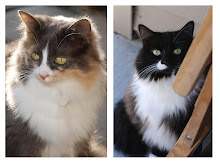
How could I resist? Today, my adorable little kitties turn eight and this is as good an excuse as any to post their photos, again. I have written many posts about my cats, talking at length about their shortcomings and how useless they are on a practical level - here is the most recent. But today, it is their birthday and so all I shall say is that they light up my life, make me smile when I am feeling blue and, all things considered, make my life and my home a better place to be.
Since this is a Macro Monday posts, here they are, in all their close up cuteness and fluffiness.
Did I ever tell you how hard it is to photograph a black and white cat? Getting the right exposure is nearly impossible. It is like trying to photograph a lump of coal on a fresh bank of brilliant white snow, except that the lump of coal refuses to sit still, even if you do try and tempt it with some cat treats.
For those of you who have not sussed it out by now, I am currently taking a Photoshop course. This week was black and white conversions. Who knew that there were so many ways to turn a colour photo into a black and white version? And who knew that you can generate an almost infinite variety of different black and white photos, depending on the conversion process used and subsequent editing? Well, I do now, and after a little messing about with Photoshop at 2am this morning (it is amazing what you can get done when you can't sleep), here are just three versions of a photo that I took of the Altiplano of Peru.
I am not entirely sure which one I like the best - it seems to depend on my mood. The top and the bottom photos have both had slight tints added, so they are not 100% monochrome.
Next week - how to make anyone look good. Not sure if I will even go to that class, given the almost complete lack of people in my photos. Let's face it, even when I do include a person, it is usually yours truely and since I am such a shy and retiring person who shuns the limelight, I always blank my face out. Besides, aside from removing very large, obvious and embarrassing zits, I am not a big fan of photoshopping someone's image until they look great, but absolutely nothing like themselves.
Oh, and for anyone who is interested, here is the original image before the B and W conversion.
It would appear that I am now one year older, but none the wiser. Being 28, again, is getting a little tiresome. Still, one thing that I have learnt is that you should never pick the prickly pear by the paw - just look at how many spines cover the surface of the succulent leaves of the prickly pear cactus. And have a look at the interesting effect of removing all colour from the photo except for the reds. As you can see, I am still messing about with Photoshop.
And since I seem to find it nearly impossible to write a post without some educational content, let's end with a few interesting facts about the prickly pear cactus. This particular one was photographed on one of the Galapagos Islands. On some of the islands, these cacti are fairly small and grow low to the ground. These islands tend to be wetter and more fertile and their resident tortoises have large domed shells which prevent the tortoise from stretching its head up very high - with all the food nice and low down, he doesn't have to. However, on some of the drier islands, the prickly pears grow into large "trees", with strong trunks holding their pad-like leaves well off the ground. On these islands, the resident tortoises have evolved saddle-shaped shells that allow them to stretch their heads up high to reach the lower cactus leaves. On all of the Islands, the prickly pear provides an important food source for many of the animals, not just the tortoises, inlcuding nectar for many of the islands different finch species.
The prickly pear is native to all of the Western hemisphere and is one of the most northern, cold tolerant species of cacti, managing to survive all the way into British Columbia, Canada. All prickly pear cacti belong to the genus Opuntia and they can make a tasty treat for humans as well as animals. To be honest, I might be lying here. I do know that you can eat various parts of the plant, but since I have never tried any part, I cannot say for sure that any part is actually tasty. Still, you can always give it a go. You can eat the fruits or the young leaf pads, but you will probably want to make sure that all of the spines have been removed first! In Mexico, the fruit is commonly called tuna, but I suspect that if I called "tuna" and my cats came running they would not be best pleased if I offered them catus fruit! The Mexicans and some South Americans also make use of the prickly pear to cultivate scale insects, from which red cochineal dye is produced.
And finally, since it seems to me that I cannot learn about anything biological without Mr. Charles Darwins' name popping up, I might as well tell you that he discovered that these cacti have thigmotactic anthers. That is just a fancy way of saying that their anthers (male bits that produce pollen), move when you touch them. Oooh eerr, missus! I think that I will say no more about male bits moving when you touch them.........
So this week I have chosen a photo that, while it looks as though it has been photoshopped quite a lot, it really hasn't. I will admit to removing the stem, since I liked the impact of just the flower head, and I have adjusted the contrast, but otherwise, it is pretty much as is. The distinctive look of the photo has been achieved in the way the photo was taken. Rather than using a harsh flash with a fast shutter speed, I essentially took the photo in the dark. The lighting was then provided by playing a flashlight over the flower head, lighting up the petals, but leaving everything else black. To get enough light into the camera using such a subtle form of lighting, the shutter has to be left open for a relatively long period of time, in this case approximately 15 seconds. Obviously, you are going to need a tripod for this one.
I really do love this effect, and you can do it on a much larger scale, so long as you have a strong enough light source. Here is a tree that I painted with light in the Namibian desert. I got into trouble for this one, since apparently leopards live in amongst the boulders and they love to come out at night and eat idiotic tourists (that would be me) that are sitting around taking photos at sunset.
If after reading one of my posts, you have the urge to email me or leave a comment, please feel free to do so - gromit1469@gmail.com Exciting news - I now have a Facebook page! You can find me by searching with my email address.
Willow and Tess - aren't they adorable?
Introducing two of the loves of my life......my beautiful, little bundles of fluff, love and laughs, Willow and Tess.
Is anybody really interested? I am starting this blog mainly because everyone keeps telling me that I am very opinionated and I thought that this would be a good way of venting about life, the universe and everything without bugging other people. Probably should let you know that I am from England, and so you may detect a hint of sarcasm in my posts, if I ever get around to making any - as well as being opinionated, I tend to get distracted easily and I find it hard to finish anything unless there is a deadline. I was going to explain the bug part, but it is time for my afternoon nap.....